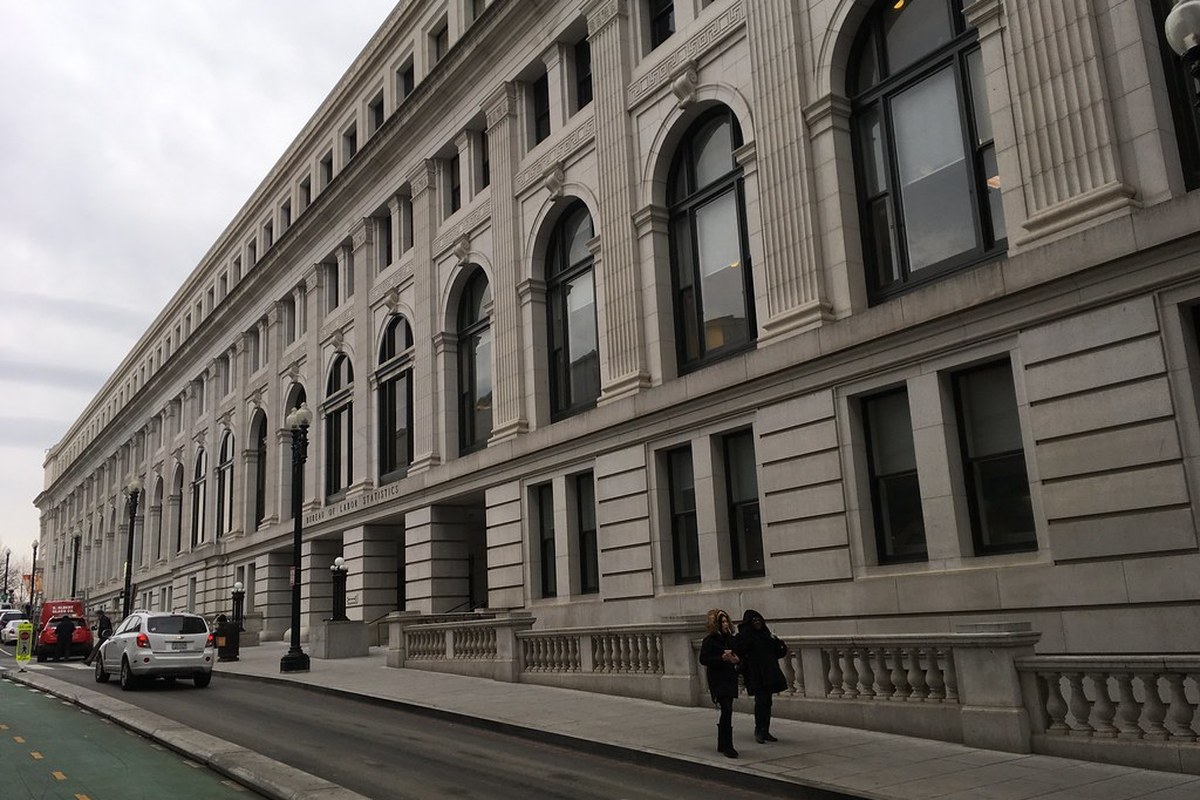
Photo: Erica Fischer. Source (Openverse). License: CC BY 2.0. Cropped and resized; photographed February 1, 2018, not the future release.
The November 2026 CPI report is scheduled for Thursday, December 10, at 8:30 a.m. EST, or 13:30 UTC. Traders checking Kalshi should separate that publication time from trading cutoffs: the observed monthly and annual contracts close at different times, and some API timing fields conflict with the linked contract PDFs.
Source snapshot: October 2, 2026, 05:31-05:33 UTC. This is a static calendar and source checklist, not a forecast, result, or live-pricing page.
Verified for the dated snapshot above: the BLS December calendar, BLS CPI release schedule, and BLS CPI FAQ; Kalshi’s exact November monthly event and November annual event; and the full CPI contract terms and year-over-year CPI terms.
December 10 is the scheduled publication date for November data, not December inflation. The CPI report scheduled for November 10 covers October data. The October CPI and November 10 release guide covers that separate event.
Both BLS calendar views identify December 10 at 8:30 a.m. Eastern. They are two views from the same official publisher, not independent confirmations from different agencies. December uses Eastern Standard Time, UTC minus five hours. The schedule remains subject to change.
The snapshot confirmed both November families, with every observed contract marked active. That does not guarantee continuing availability. The compact comparison is:
These are different measurements, not interchangeable expressions of one number. Core CPI, which excludes food and energy, is also a separate measure and must not replace the all-items measure specified by these contracts.
Both event records identify BLS CPI as the settlement source and mark the contracts as nonexclusive. Multiple threshold contracts can resolve Yes. Their probabilities should not be summed as though they were mutually exclusive forecast buckets.
For broader mechanics, see the CPI inflation-market guide. Its general discussion is not evidence of an exact November cutoff.
The November monthly short rules state:
“The market will always close at 8:25 AM ET on the scheduled day of the data release (December 10, 2026). Please note: the Expiration Value is the single-decimal value published at the Source Agency.”
That agrees with the monthly API close field. However, the generic CPI PDF specifies an 8:29 a.m. ET last trading time and 8:31 a.m. ET expiration. The November monthly API instead lists expected expiration at 9:56 a.m. EST, 14:56 UTC.
The annual PDF’s 8:29 a.m. trading cutoff agrees with the annual API close. Its generic 8:31 a.m. expiration differs from the API’s expected expiration of 10:00 a.m. EST, 15:00 UTC.
Three clocks must therefore remain separate:
The evidence does not establish legal precedence between conflicting fields or show that either PDF has been amended. Inspect the current full terms and ask Kalshi to clarify unresolved inconsistencies before relying on a cutoff.
The verified monthly example, KXCPI-26NOV-T0.2, resolves Yes if CPI increases by more than 0.2%, using the published single-decimal value. Hypothetically, 0.2% would not satisfy that condition; 0.3% would. Neither number is a forecast.
The annual example, KXCPIYOY-26NOV-T3.0, asks whether the twelve-month increase exceeds 3.0%, using BLS’s one-decimal reported value. Its measurement period differs from the monthly example.
Both PDFs state: “Revisions to the Underlying made after Expiration will not be accounted for in determining the Expiration Value.” That is narrower than claiming the first print always wins. Both also contain no-data fallback formulas, expiration-adjustment provisions, and outcome-review contingencies.
The monthly short rules include a shutdown-related data-delay contingency that can extend expiration. It is a conditional provision, not evidence that a shutdown or delay will occur; consult the linked exact event and full terms.
Any outcome update belongs on this same page only after the actual December 10 release and supporting evidence.
BLS schedules the report for Thursday, December 10, 2026, at 8:30 a.m. EST, equivalent to 13:30 UTC. Both official calendar views show that appointment. It is a scheduled publication time, not a guarantee against changes, and it is separate from Kalshi trading cutoffs and expected-expiration fields.
The December 10 report covers November inflation. The month named in the CPI reference period is not necessarily the publication month. By contrast, the report scheduled for November 10 covers October data. Traders should match the contract’s reference month to the BLS schedule rather than rely on the release month alone.
The monthly family measures a one-month, seasonally adjusted CPI-U percentage change. The annual family measures the all-items CPI-U percentage increase before seasonal adjustment over twelve months ending November. Both use one-decimal values under the checked terms. Neither should be evaluated using core CPI instead of its specified underlying measure.
The observed November monthly contracts close at 8:25 a.m. EST, while annual contracts close at 8:29 a.m. EST. The monthly PDF gives a different generic cutoff, and both PDFs’ expiration times differ from API expected-expiration fields. Readers should inspect current contract-specific rules and obtain clarification rather than assume one universal time.
Not financial advice. Prediction-market trading is speculative, and you can lose money. Do your own research.