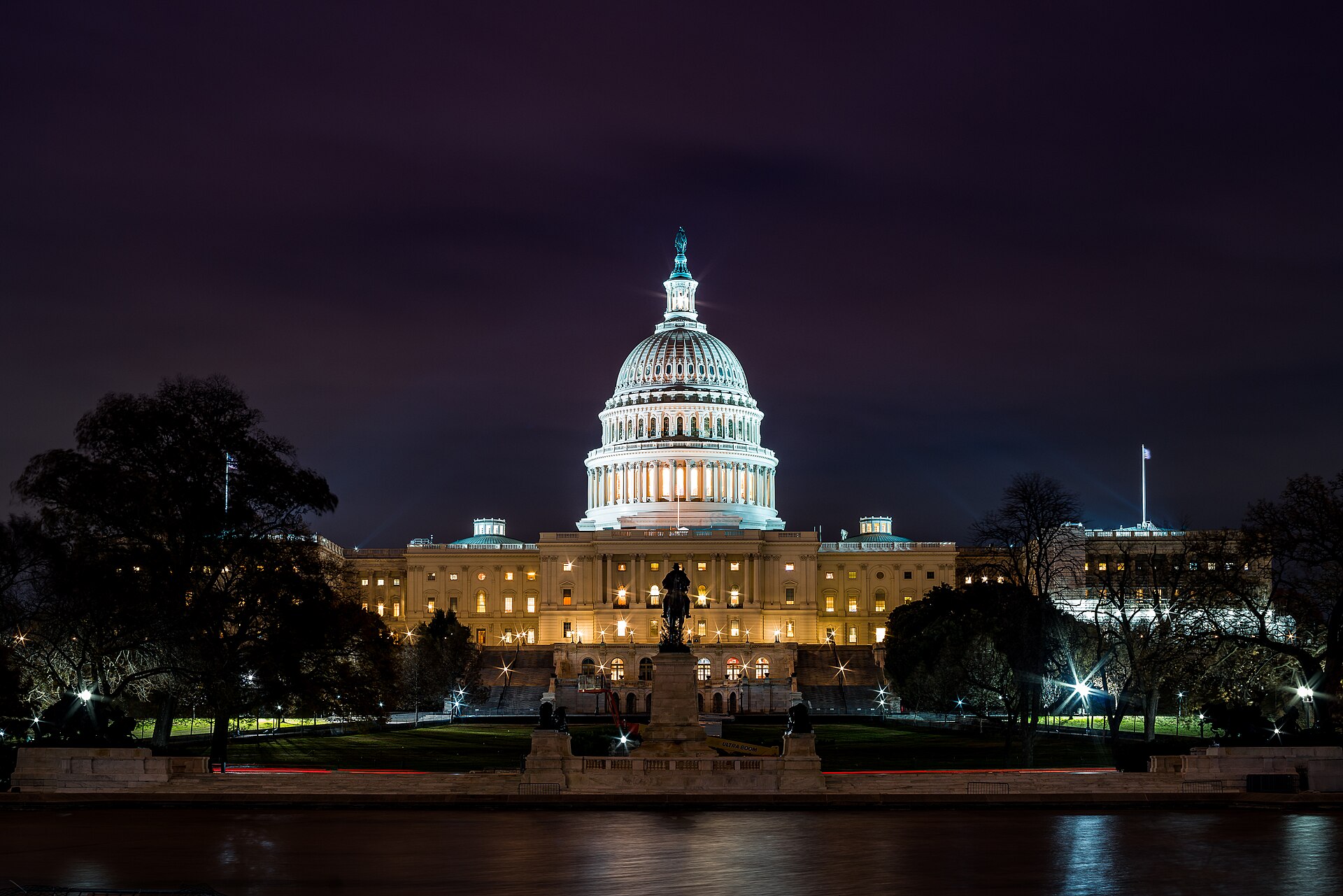
Photo: John Brighenti. Source (Wikimedia Commons). License: by.
A House majority projection could arrive on election night, several days later, or after enough close races become clear. Traders should separate the timing of an Associated Press call from the settlement rules and closing times of related Kalshi election contracts.
Primary sources checked: the Kalshi Elections API snapshot, the Federal Election Commission election information page, and the federal government’s midterm elections guide. Sources were checked from 05:30 to 05:45 UTC on September 16, 2026.
Kalshi is a CFTC-regulated designated contract market. Its contracts are USD-settled, and identity verification is required. Eligibility can vary under the Member Agreement, restricted-jurisdiction rules, and local law.
There is no fixed time when the House majority must be called. Election Day is November 3, 2026, with all 435 House seats scheduled for election. Polls close on Tuesday evening according to state law, but counting and reporting continue afterward.
The answer depends on whether enough decisive races report quickly. A small number of unresolved districts can prevent a national majority projection even when many individual races have already been called. Exact polling hours should be checked through state election offices or the links collected by the FEC.
The search question, when will the 2026 House majority be called? election night timeline and Kalshi settlement sources, therefore has two parts. The first concerns when AP makes a public projection. The second concerns what a particular Kalshi contract recognizes as a qualifying call.
As of September 16, Kalshi’s API showed an event titled “When will AP call the 2026 U.S. House majority?” It contained eight active before-threshold markets. Current availability, prices, fees, and full rules must be verified directly on Kalshi.
These are cumulative before-threshold questions, not exclusive time buckets. A qualifying call before an early deadline would also be before later deadlines, subject to each market’s exact rules. A listed close time should not be treated as a promise that settlement will occur at that moment.
The snapshot rules require an explicit declaration that a candidate, party, or option “has won, will win, is projected to win,” or equivalent clear language. The call must appear on a primary AP platform, such as its main website, television broadcast, or qualifying official social media.
The relevant time is when the call first becomes publicly visible, not when AP may have prepared or internally approved it. The rules also state that a later retraction does not erase the initial qualifying call.
Several items do not qualify under the displayed rules:
This distinction matters more than election commentary or a trader’s interpretation of partial results. Settlement follows the contract text, not the general sense that one party is favored to control the chamber.
House call-timing markets should not be confused with seat-count or chamber-control markets. The September 16 API snapshot separately showed 11 active Republican House seat-count markets, 12 active Democratic House seat-count markets, and one market asking whether the same party would control the House and Senate. Those events had API close times of February 1, 2027. The related Senate-control overview covers which official sources those markets track.
The related Senate-control event illustrates why full rules matter. Its secondary rules stated: “This market may be determined early based on a consensus of media calls projecting control of the U.S. Senate. See full rules for details. Otherwise, victory will be determined by the party identification of the President pro tempore of the Senate on February 1, 2027.”
That language applies to the cited Senate event. Traders should not transfer it automatically to a House call-time or seat-count contract. Each market can use a different question, observation time, early-determination provision, and fallback source.
Updates and related market notes are also posted through the @Kalshi_market channel. The useful answer to when will the 2026 House majority be called? election night timeline and Kalshi settlement sources remains rule-specific rather than predictive.
No guaranteed call time exists. AP could project the majority on November 3, during the following days, or later if decisive districts remain unresolved. The September 16 Kalshi snapshot used thresholds ranging from before 11 PM ET on election night through before January 1, 2027, but traders must check current listings directly.
No. An AP majority projection may be relevant to a contract specifically based on the first qualifying AP call. House seat-count, chamber-control, and combined-control markets can have different settlement language, dates, and fallback sources. Traders should read the full rules for the exact market rather than applying one event’s terms to another.
Current availability, prices, fees, eligibility, and exact settlement language should come directly from Kalshi. Official election context can be checked through the FEC, USA.gov, and state election offices. Archived or dated API data can establish what was listed at a particular time, but it does not guarantee that a market remains available.
A national House projection requires enough district outcomes to establish which party will hold a majority. Close margins, incomplete counting, provisional ballots, mail ballots, and unresolved individual races can delay that determination. A large number of called districts does not necessarily produce a chamber call if the remaining seats could still change control.
Not financial advice. Prediction-market trading is speculative, and you can lose money. Do your own research.
.jpg)