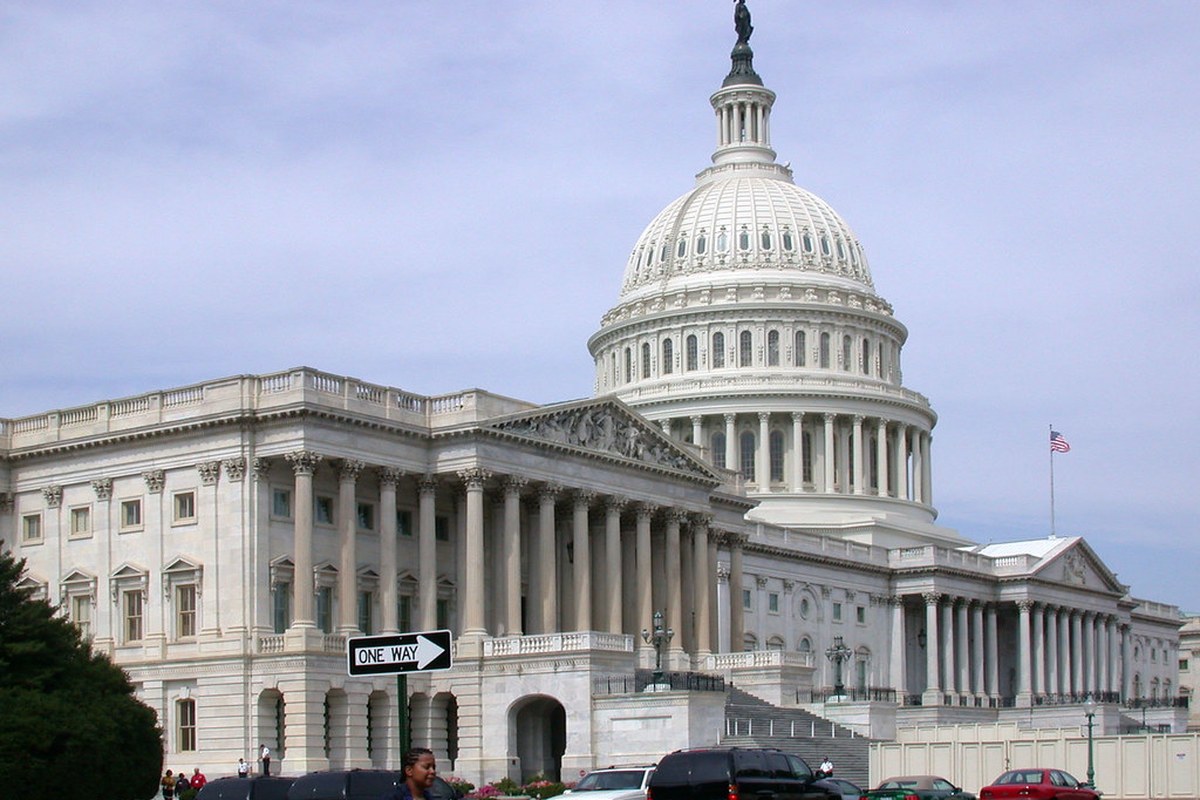
Historical photo: Ed Uthman (euthman), U.S. Capitol, September 23, 2002. Not an election-night image. Source (Openverse). License: CC BY-SA 2.0. Resized for this page.
The 2026 U.S. congressional general election was Tuesday, November 3, 2026. This 2026 midterm election calendar and Kalshi contract checklist separates that federal date from state voting deadlines and the rules governing individual prediction-market contracts. Sources and Kalshi API availability were checked on August 18, 2026, and rechecked on October 26, 2026. The November 7 update separates already-finalized control and call-timing contracts from still-active seat-count contracts. A media declaration of control does not by itself answer how many seats a party will hold on the date specified in another contract. The earlier snapshots and November 1 correction remain below as history; exchange outcomes are not a certified tally or an independently established AP call time.
Primary sources checked: the official GovInfo text of 2 U.S.C. § 7, the USA.gov midterm election page, the USA.gov registration deadline guide, and the National Governors Association election page.
Source snapshot: This page was checked on August 18, 2026, from 06:15 to 06:25 UTC, 77 days before Election Day. Registration deadlines, voting procedures, market availability, prices, fees, and contract terms can change, so readers should reopen the official sources before acting. The dated October 26 check is preserved below with a clearly labeled November 1 correction. The November 5 contract snapshots were captured on November 5 at 05:31 UTC (12:31 a.m. EST) and checked on both Kalshi public API hosts. Historical editorial review: November 5, 2026. The November 4 05:32 UTC snapshots and their review are retained in the dated historical section; earlier source dates remain attached to their own checks. This page is not a live results feed.
The useful distinction: Kalshi has recorded final outcomes for Senate control and AP’s House-call timing, but that does not mean every 2026 congressional contract has settled. Fresh reads from both official public API hosts found 27 active seat-count contracts with empty results in the two exact events below. This is a bounded snapshot, not an inventory of every election product or a live quote.
| Exact event | Checked state | What the question measures |
|---|---|---|
| CONTROLS-2026 | 2 finalized: Democratic Yes, Republican No | Senate control; CONTROL permits its own media-consensus route. |
| KXAPCALLHOUSE-26AUG20 | 8 finalized: 3 No, 5 Yes | When AP made a qualifying House-majority call, not a seat total. |
| KXDHOUSESEATS-27 | 12 active; results empty | Democratic House seats on February 1, 2027. |
| RSENATESEATS-27 | 15 active; results empty | Republican Senate seats on February 1, 2027. |
Independent Senate corroboration, November 7: five of CONTROL’s eight named national publishers independently report Democratic Senate control: NBC News, Fox News, CBS News, ABC News and CNN. All five retrieved pages agree on the party; no final certified seat total is asserted here. This corroborates the recorded Senate outcome, but it does not reconstruct which four declarations Kalshi used at determination or establish the rule’s no-contradiction condition across all eight sources. AP, NYT and DDHQ are not counted as verified declarations in this review. Article update dates and live-blog entry times are not automatically the first qualifying call time.
Why an election-night tally is not enough for these seat contracts: both seat-count series link to the full SEATSCONGRESS terms. The underlying is the identity and partisan membership of the House and Senate on February 1 following the beginning of the term, documented by the United States Congress. People caucusing with a party count with that party, including an Independent who caucuses with it. Revisions made after expiration are excluded. The terms do not supply a separate explicit vacancy-counting clause; do not invent one.
Read the condition, not just the ticker: the actual KXDHOUSESEATS-27-232 question is between 230–233 House seats, with both endpoints included under the full terms. The suffix “232” is not an exactly-232 condition. By contrast, RSENATESEATS-27-E57 asks for exactly 57 Senate seats. These are examples of contract wording, not predictions of the final count.
Four different clocks: the checked seat records list close and expiration at February 1, 2027, 15:00 UTC (10 a.m. EST). The full terms allow the next date data is available if it is unavailable on February 1; settlement is no later than the day after expiration unless the outcome is under review. These are specified criteria and timing provisions, not a guarantee that funds arrive on February 1. Although the API has can_close_early=true, that flag does not supply an alternate settlement criterion. SEATSCONGRESS contains no four-of-eight media-consensus clause: do not borrow the separate CONTROL rule to treat seat counts as resolved.
Source trail and limits: compare the 12 House-seat records with their series terms/source, and the 15 Senate-seat records with their series terms/source. Retrieval times above are this review’s source snapshots; the recorded settlements below happened on November 4. AP’s public House results page was reachable, but its underlying results-data feed was access-blocked. The exact first AP public-call timestamp and the complete independent Senate media-consensus reconstruction therefore remain unverified here. An active seat market does not prove that no media call exists, and a finalized control market does not prove all seat counts are final.
What changed: the November 5, 05:31 UTC readings now show both Senate-control contracts and all eight AP House-call contracts as finalized, with nonempty results and settlement_ts. The Senate pair remains Democratic Yes / Republican No. Its recorded settlement is November 4, 05:46:56 UTC (12:46:56 a.m. EST), after the 04:46:52 UTC close. The retained February 1 expiration field was not the actual settlement date. Times here are shown to the second; raw API records include fractional settlement seconds.
| Exact suffix | Before this cutoff | Result |
|---|---|---|
| NOV0311P | 11 p.m., November 3 | No |
| NOV0412A | Midnight, start of November 4 | No |
| NOV041A | 1 a.m., November 4 | No |
| NOV044A | 4 a.m., November 4 | Yes |
| NOV0612A | Midnight, start of November 6 | Yes |
| NOV1112A | Midnight, start of November 11 | Yes |
| NOV1412A | Midnight, start of November 14 | Yes |
| JAN0112A | Midnight, start of January 1, 2027 | Yes |
The eight House-call records show settlement on November 4 between 07:48:55 and 07:49:30 UTC (2:48:55 to 2:49:30 a.m. EST). The five Yes markets share a 07:19:29 UTC close (2:19:29 a.m. EST). That is Kalshi’s close time, not a verified AP publication time. The No/Yes threshold pattern is useful for reading the resolved ladder; it does not establish the exact first-public-call instant. These contracts ask when a call occurred, not which party won the House.
Source limits still matter after finalization: direct access to AP’s election hub returned HTTP 403 during this check. No House winner, certified seat count or exact AP call time is asserted. The full call-timing terms require the outlet’s clear first public call; “projected to win” by itself is insufficient, and test posts or technical errors are excluded. The Senate terms permit early determination using at least four of eight named media sources with no contradictory declaration; this review did not independently reconstruct that consensus. A finalized exchange record is evidence of Kalshi’s outcome, not a substitute for either source check or an individual account’s payment history.
The separate pre-election majority-loss contract remains finalized No. Its school-district source metadata still conflicts with the chamber/news-source terms; finalization does not repair that mismatch. The broader named-source follow-ups remain open. For the call rules and cutoff framework, see the existing House-call guide; its earlier snapshots are historical, not current results.
What changed since November 1: at the November 4, 05:32 UTC snapshot, Kalshi’s two Senate-control contracts no longer showed active, empty-result records. They showed status=determined, with result=yes for CONTROLS-2026-D and result=no for CONTROLS-2026-R. Neither returned a settlement timestamp. This is a report of Kalshi’s exact contract records, not an independently certified Senate seat tally or evidence that any account has received funds.
| Exact contract or group | Observed status / result | What this does not prove |
|---|---|---|
| CONTROLS-2026-D / CONTROLS-2026-R | determined / Yes and No respectively; both closed November 4 at 04:46:52 UTC | No settlement timestamp was returned; a completed payout is not established. |
| KXAPCALLHOUSE-26AUG20-NOV0311P | closed / empty result; close November 4 at 04:00 UTC = November 3 at 11 p.m. EST | Passing the cutoff does not itself establish a Yes or No outcome. |
| KXAPCALLHOUSE-26AUG20-NOV0412A | closed / empty result; close November 4 at 05:00 UTC = November 4 at midnight EST | A closed market is not evidence of a qualifying AP call or its time. |
| The six later KXAPCALLHOUSE-26AUG20 windows | active / empty results | Remaining open is not evidence that AP has or has not made a qualifying call. |
| KXLOSEMAJORITY-27JAN01 | finalized / No; settlement timestamp November 3 at 16:07:37 UTC | This is the pre-election majority-loss question, not the winner of the House election. |
Senate timing: the observed 04:46:52 UTC close was 11:46:52 p.m. EST on November 3. The same records still retained February 1, 2027 at 15:00 UTC in their expiration fields. That contrast is why a listed expiration must not be substituted for the actual close or settlement. The full CONTROL terms permit accelerated resolution when at least four of eight designated media sources declare a winner and none issue a contradictory declaration. They name NYT, AP, Decision Desk HQ, CNN, Fox News, NBC News, CBS News and ABC News. This check did not independently verify all of those declarations or identify which four Kalshi used; it therefore attributes the reported outcome only to Kalshi. The ordinary fallback remains the party of the Senate’s President pro tempore at expiration.
House-call timing remains unresolved in this check: the eight AP-call records included two closed windows and six active ones, all with empty results. The six later suffixes were NOV041A, NOV044A, NOV0612A, NOV1112A, NOV1412A and JAN0112A. Their presence is a dated inventory, not a live trading recommendation. The ELECTIONTIMECALL terms require the outlet’s first publicly visible, clear election call before the specified cutoff. A bare “projected to win” phrase is insufficient unless it is the outlet’s definitive call. A genuine qualifying call later retracted is distinct from an excluded technical glitch or test post. A direct AP election-hub read was blocked during this check, so no AP call time or House winner is asserted here.
Pre-election majority-loss result, separate from the midterms: KXLOSEMAJORITY-27JAN01 asks whether Republicans lose majority control after issuance and before November 3. It now reports finalized / No, closed November 3 at 15:37:33 UTC, with a 16:07:37 UTC settlement timestamp. The later January 8 expiration field did not extend its occurrence window. Its series still lists an unrelated school district as the source, while the full terms list an official-chamber/news-source hierarchy. Finalization does not resolve that metadata mismatch, which remains explicitly unverified here.
How to use the update: distinguish active, closed with no result, determined with a reported result, and finalized with a settlement timestamp. Those are the literal fields observed here, not interchangeable promises about payment. Kalshi’s Market Rules guidance explicitly warns that an open or undetermined market is not evidence that its resolution criteria have or have not been met. Its Market Outcomes guide separates closure from determination. Recheck the exact market, full rules and review provisions; the broader midterm-result and House-call follow-ups remain open.
Correction, November 1, 2026: the October 26 version incorrectly inferred that none of the checked markets could settle on November 3 from their listed UTC close times. That inference was not supported. In particular, 2026-11-04T04:00:00Z is 11 p.m. EST on November 3 in New York, not November 4 locally. A trading deadline, a qualifying event, expiration and completed settlement are separate facts.
The FEC election page still lists Tuesday, November 3 as the federal general-election date. Its reminder that state offices certify election results does not replace a market's own named source. The following contract checks were captured from Kalshi's public API on November 1 at 05:31 UTC and reviewed with the linked full terms the same day; no winner or completed payout was observed in these records.
KXAPCALLHOUSE-26AUG20 had eight active markets. The earliest, NOV0311P, asks whether AP makes its first definitive House-majority call before 11 p.m. ET on November 3. Its listed close and expiration are 04:00 UTC November 4. All eight carry an early-close condition tied to AP's definitive call. The separate expected-expiration field is January 8, 2027 at 15:00 UTC; it is not a promise that funds arrive that day. The full call-timing terms, pages 1-2, require a clear call on the outlet's primary platform: "projected to win" wording alone is insufficient. The first public time matters, not private preparation; a qualifying call later retracted is different from an excluded technical glitch or test post.CONTROLS-2026 had two active markets with a listed February 1, 2027, 10 a.m. EST close. The CONTROL terms, page 2, permit accelerated resolution when at least four of eight designated media sources declare a winner and none contradict. One AP call alone is not that test. The ordinary Senate criterion is the party of the President pro tempore on the expiration date; the series names congress.gov. Neither the February field nor early-resolution permission guarantees a payout time.KXLOSEMAJORITY-27JAN01 asks whether Republicans lose their House majority after issuance and before November 3. Its January 8 close field does not extend that occurrence window. The series metadata currently lists an unrelated school district as its settlement source, while the full majority-control terms describe a hierarchy of official chamber and news sources. That mismatch is unresolved here: do not silently substitute a source or treat this as a House-election-winner contract.Before relying on a deadline: record the exact question and local time zone, then read early-close, expiration, source and review provisions independently. Kalshi's Market Outcomes guide says outcome determination follows closure and can take one hour to more than twelve; it is not an instant-payment promise. For the fuller call-window comparison, use the existing election-night House-call guide. Results will be checked only after source evidence exists.
This checklist was rechecked on October 26, 2026, between 15:02 and 15:07 UTC, eight days before Election Day, against the live GovInfo statute, both USA.gov pages, the FEC voting page, the National Governors Association election page, and Kalshi’s public Elections API. The official calendar facts did not move; the concrete changes since August are that the NGA list now carries named general-election candidates and that the API listed later UTC close fields. The November 1 correction above explains why those fields did not establish local-day settlement timing.
CONTROLS-2026 (which party wins the U.S. Senate), 2 of 2 markets active and mutually exclusive, close 2027-02-01T15:00:00Z; the pre-election House-majority-loss market KXLOSEMAJORITY-27JAN01, active, close 2027-01-08T15:00:00Z; the seat-count events KXRHOUSESEATS-27 (11 of 11 active) and KXDHOUSESEATS-27 (12 of 12 active), each closing 2027-02-01T15:00:00Z; the eight AP House-majority call windows KXAPCALLHOUSE-26AUG20 (8 of 8 active, from before 11 PM ET on November 3 to before 12 AM ET on January 1, closing 2026-11-04T04:00:00Z through 2027-01-01T05:00:00Z); the governor-balance event KXGOVWINS-27JAN01 (3 of 3 active, close 2027-01-01T14:59:00Z); and KXSAMEPARTYCONGRESS-27FEB01 (1 of 1 active, close 2027-02-01T15:00:00Z). Two sampled public order books (CONTROLS-2026-D and KXRHOUSESEATS-27-220) carried no resting levels at the 15:03 UTC read, and the markets’ last-price fields were null. Those are dated structural facts, not quotes, probabilities, or liquidity claims.KXSENATE and KXHOUSE series endpoints returned zero open events at this read; the live control markets sit under the series named above. Settlement still depends on each contract’s stated outcome criteria and verification source, and the four-checkpoint calendar and exact-contract checklist below stand unchanged.Election Day is Tuesday, November 3, 2026. Federal law schedules the election of Representatives and Delegates for the Tuesday after the first Monday in November of every even-numbered year. In 2026, the first Monday is November 2, making the following Tuesday November 3.
That date does not create one national deadline for registration, mail ballots, or early voting. USA.gov says registration deadlines vary by state and can fall as much as a month before an election. Voters should use Vote.gov and the relevant state or territory election office rather than relying on a general calendar.
Election Day is also not automatically a Kalshi settlement date. A contract may depend on a later event, verification condition, or source specified in its rules. A race call, concession, preliminary count, certification, or congressional action should not be treated as controlling unless the exact contract says so.
USA.gov says all 435 U.S. House seats are up for election in each midterm and presidential election year. It also says roughly one-third of the U.S. Senate is elected every two years. This guide does not substitute an unsupported precise count of 2026 Senate contests or special elections.
The National Governors Association lists 39 gubernatorial elections across states and U.S. territories in 2026. That should not be shortened to 39 state races because the official list includes territories.
Individual ballots may also contain state legislative, local, judicial, or ballot-measure contests. Their presence and wording depend on the jurisdiction. Kalshi should not be assumed to offer a contract for every House, Senate, governor, local, or ballot-measure race.
For narrower coverage, use the separate 2026 Senate-control source checklist, House markets guide, and 2026 primary election guide.
At the August 18, 2026 snapshot, Kalshi’s public Elections catalog and exact market endpoints returned active election-cycle contracts covering a pre-election House-majority change, the 2026 House popular-vote margin, Speaker of the 120th House, and post-midterm governor balance. The checked pre-election majority-loss API endpoint returned an active market at that time.
Those dated checks establish election-cycle relevance only. They do not establish present availability, a price, liquidity, eligibility, fees, close time, expiration, payout terms, or the date and method of settlement for any reader.
Before trading any 2026 election contract, check:
Kalshi states that every market has its own rules, outcome criteria, and verification source. The Kalshi Market Rules guide and market outcomes guide explain the framework, but the exact contract page controls. Treat this 2026 midterm election calendar and Kalshi contract checklist as a verification process, not as a substitute for those terms. Updates and related market notes are also posted through the @Kalshi_market channel.
The 2026 U.S. congressional general election was Tuesday, November 3, 2026. The FEC and GovInfo schedule were rechecked on November 1. Registration, early-voting and mail-ballot deadlines are separate and vary by state or territory; consult your state or local election office.
All 435 U.S. House seats and roughly one-third of the U.S. Senate are involved, according to USA.gov. The National Governors Association also lists 39 gubernatorial elections across states and territories; the October 26 recheck counted the same 39 races on the live list, which now names the general-election candidates. State legislative, local, judicial, and ballot-measure contests depend on each jurisdiction’s official ballot.
In the November 7, 2026 API check, the two Senate-control contracts and all eight AP House-call windows were finalized. In contrast, all 12 checked Democratic House-seat contracts (KXDHOUSESEATS-27) and all 15 Republican Senate-seat contracts (RSENATESEATS-27) remained active with empty results. These are different questions: the seat-count rules measure congressional composition on February 1, 2027. This dated inventory is not live availability or a certified seat tally.
There is no universal settlement time. Kalshi records Senate-control settlement on November 4 at 05:46:56 UTC and AP House-call settlement between 07:48:55 and 07:49:30 UTC. The two checked seat-count events instead list February 1, 2027, 15:00 UTC (10 a.m. EST); their underlying is February 1 congressional composition. Expiration may move to the next date data is available, with settlement no later than the day after expiration unless under review. The four-of-eight media clause belongs to CONTROL, not SEATSCONGRESS. Neither an exchange close field nor a media call proves when an individual account receives funds.
Not financial advice. Prediction-market trading is speculative, and you can lose money. Do your own research.