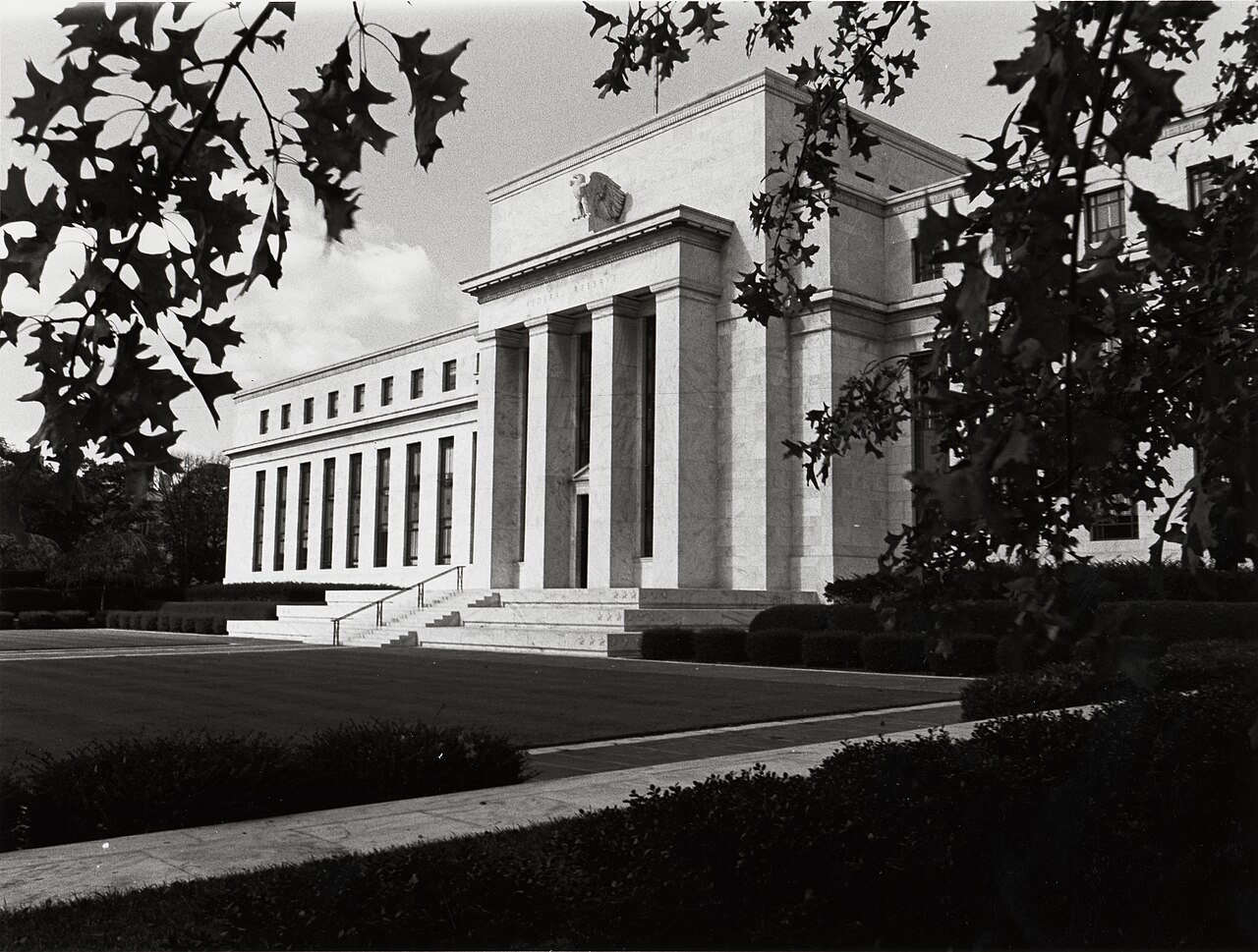
Real Federal Reserve photograph by Board of Governors of the Federal Reserve System / Wikimedia Commons, public domain in the United States.
The generic terms define the underlying as an FOMC decision to change or not change the target federal funds rate range. A listed action can be a hike, a cut, or no change. A listed meeting can name a date or refer to the next scheduled FOMC meeting. The Federal Reserve System is the source agency.
| Term | FEDDECISION language reviewed | Practical check |
|---|---|---|
| Underlying | FOMC decision to change or not change the target range | Do not substitute a speech, forecast, vote count, or later minutes |
| Action | Raise, cut, or no change, with any amount specified by the strike | Read comparison words and basis-point threshold exactly |
| Minimum tick | $0.01 | A one-cent move is one percentage point of the $1 payout before fees |
| Last trading time | 1:55 PM ET | Do not plan to trade this contract after seeing the scheduled 2:00 PM statement |
| Expiration time | 2:05 PM ET | The official decision should determine the expiration value |
| Settlement | No later than the day after expiration unless outcome review applies | Settlement need not be instantaneous |
Kalshi's help center says every market has its own rules on the market page, including the successful outcome and verification source. Treat the generic PDF as the series framework and the live market's wording as the final pre-trade check.
The Federal Reserve says the FOMC holds eight regularly scheduled meetings each year and other meetings as needed. Its calendar links the statement, implementation note, press conference, projection materials when applicable, and minutes. Minutes of a regularly scheduled meeting are normally released three weeks after the policy decision.
CME says FedWatch uses 30-Day Fed Funds futures pricing to show probabilities for target-rate outcomes at upcoming FOMC meetings. That makes it a useful independent comparison. It is not automatically the same payoff as a Kalshi action contract.
Use this normalization sequence:
For example, a Kalshi strike asking whether the FOMC will cut by more than 25 basis points does not include a 25-basis-point cut. A FedWatch row for a target range exactly 25 basis points below the starting range belongs in the No side of that particular wording.
The top quote is only enough for the quantity displayed there. Kalshi's order-book help defines the book as resting orders with their prices and quantities. For an order that crosses several levels, calculate the full-size volume-weighted average price (VWAP).
Suppose 100 YES contracts can be bought as follows:
| Ask | Quantity | Cost |
|---|---|---|
| $0.63 | 40 | $25.20 |
| $0.66 | 60 | $39.60 |
| Total | 100 | $64.80 |
The top ask is 63 cents, but the pre-fee break-even for the complete order is 64.8%. If your independently estimated probability is 68%, gross expected value before fees is:
Fees and any execution change reduce that margin. Use the live fee schedule and the actual order response. Our Kalshi slippage calculator walks multiple levels, while the payout calculator separates cost, maximum loss, gross payout, and break-even inputs.
A 65-cent trade is evidence of one execution. It is not a Federal Reserve forecast, a confidence interval, or proof of a 65% true probability. Spread, depth, fees, participant mix, and stale trades all matter.
FedWatch displays target-rate ranges. FEDDECISION strikes can describe actions and thresholds. Normalize the starting range and exact inequality before calling a difference a disagreement.
A recent trade is historical. The quantity you can buy now comes from current resting asks across enough levels to fill the order. See the worked thin-market and VWAP checklist.
The reviewed generic terms stop trading five minutes before the scheduled 2:00 PM decision release. Verify the live close time and do not build a strategy around impossible post-release execution.
A trader can be directionally right about easing and still be wrong on a strike requiring a larger cut, a particular meeting, or a strict threshold. Contract wording determines settlement.
The FEDDECISION PDF contains several edge cases worth reading before entry:
These are not side notes. They explain why a market can remain unsettled temporarily and why a later narrative about the meeting does not necessarily alter the recorded expiration value.
The generic FEDDECISION terms define the underlying as an FOMC decision to change or not change the target federal funds rate range. The Federal Reserve System is the source agency. A listed strike resolves according to its exact payout criterion and the live market rules, with a $1 settlement value for the winning outcome.
The FEDDECISION terms reviewed July 17, 2026 list 1:55 PM ET as the last trading time and 2:05 PM ET as the expiration time. Always confirm the live market page because the specific market rules control and terms can change.
A contract price is a market price, not an official probability or a guarantee. The executable break-even estimate also depends on which side you buy, the quantity available across order-book levels, fees, and your ability to hold through settlement.
Yes, but normalize the outcomes first. FedWatch derives target-rate probabilities from 30-Day Fed Funds futures, while a Kalshi strike follows its own action wording and settlement rules. Compare equivalent outcomes and timestamps, then account for Kalshi spread, depth, and fees.
The FEDDECISION terms reviewed July 17, 2026 say a strike listed for no change resolves Yes and all other markets resolve No if the Federal Reserve cancels the target meeting. Read the current market rules before relying on this contingency.
The generic terms say revisions to the underlying made after expiration are not counted when determining the expiration value. FOMC minutes are normally released three weeks after the policy decision, so they are context for policy analysis rather than the initial decision value used at expiration.
Educational information only, not financial advice. Event contracts are speculative and can lose the full amount paid. Verify the current market rules, order book, fees, and official source before trading.
