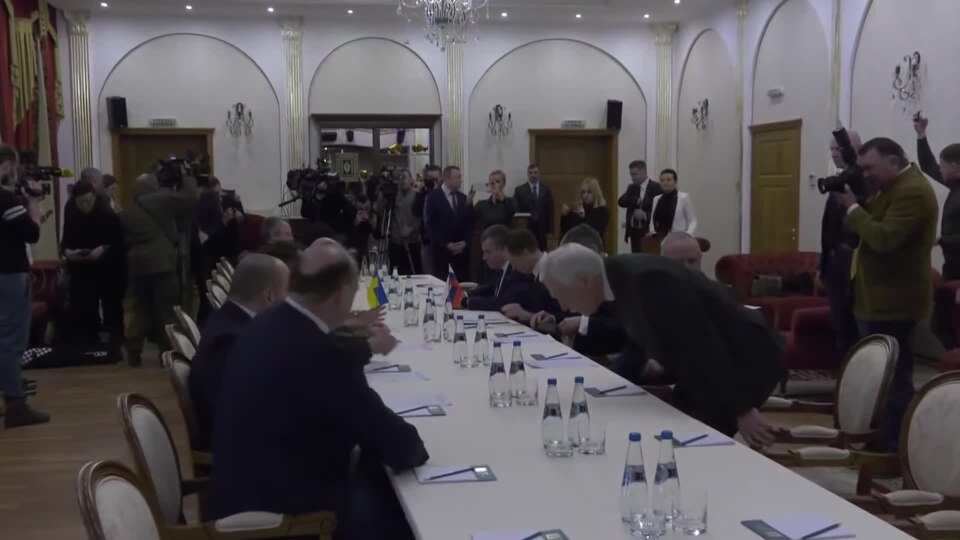
Documentary frame: BelTA / Wikimedia Commons, CC BY 3.0. Frame supplied by the Commons video preview; no synthetic imagery.
Primary sources I checked: Kalshi's banned-markets policy, an exact archived Trump-Zelensky mention market, Kalshi's rules-summary guide and market settlement FAQ, the current Kalshi Member Agreement, and the U.S. Department of State's Ukraine page for official diplomatic context.
A search result containing the words “Russia,” “Ukraine,” or “ceasefire” does not establish what a contract measures. The underlying, rules, ticker, source, and payout criterion do that.
| Possible page | What would resolve it | What it does not prove |
|---|---|---|
| Direct ceasefire outcome | Whether specified parties reach, announce, implement, or maintain a qualifying ceasefire by a deadline. | A word appearing in a speech or headline is not enough. We did not verify this direct Kalshi listing, and Kalshi says war markets are banned. |
| Word-mention contract | Whether a named person says “ceasefire” during a defined qualifying event, under exact language and source rules. | It does not resolve on a diplomatic agreement, battlefield change, or duration of peace. |
| Broader politics contract | A separately defined speech, appointment, election, policy, or diplomatic event. | Its topic can involve Ukraine without becoming a Russia-Ukraine ceasefire outcome contract. |
This distinction matters because a correct forecast about negotiations can still lose a word-mention contract if the specified speaker never uses the exact qualifying term. The reverse is also true: a speaker can say “ceasefire” without any ceasefire occurring.
Kalshi's current policy says violent markets, including war and kidnapping markets, are banned and not allowed by the CFTC. The same page lists war, death, nuclear war, assassination, kidnapping, rocket explosion, and missile strike markets among topics it does not offer.
That policy is stronger evidence than an old third-party list or a search snippet. It means readers should not describe Kalshi as offering a direct Russia-Ukraine war-outcome contract without an exact, current Kalshi market page and rules that demonstrate otherwise. This article did not find such a page in its July 17 review.
The policy does not mean every contract containing a conflict-related word is prohibited. A speech contract can measure a public utterance. The underlying event is then the speech, and the exact market rules decide what counts.
Kalshi's archived December 2025 page asked what Donald Trump would say during a meeting with Volodymyr Zelensky. “Ceasefire” appeared as one strike alongside other words. The market page categorized it under politicians and measured speech at a specified event.
That is not semantic trivia. It changes every part of the contract:
Archived pages can help explain product structure, but they are not evidence that the same market is open today. A past volume figure is also not current liquidity.
The Kalshi markets hub explains the series-event-market hierarchy. The slippage calculator can model a hypothetical fill, but it does not fetch live prices or verify whether a market exists.
Real-world reporting can inform a forecast, but the contract's named source controls settlement. Kalshi's market FAQ says trading may close before or after the apparent event and settlement can wait for the official source agency. A headline that feels conclusive is not a substitute for the rule text.
For mention markets, inspect exact-word rules, plural or possessive treatment, grammatical inflections, speaker identity, live-event requirements, replay exclusions, cancellation terms, and fallback transcripts. For any other contract, use its own rules rather than copying the structure of a nearby market.
The Kalshi Member Agreement reviewed on July 17, 2026 lists Russia and Ukraine among restricted jurisdictions for trading Event Contracts. The restriction is about the user's location or domicile and the product; it is separate from the subject of a contract. A US user reading about Ukraine and a user physically located in Ukraine are not the same eligibility question.
Agreements, sanctions, jurisdictions, and product access can change. Always read the current agreement and the eligibility information shown in the account. Do not use a VPN or location workaround to evade restrictions.
We could not verify a live Kalshi contract on July 17, 2026 whose underlying outcome was whether Russia and Ukraine reached a ceasefire. Kalshi's published banned-markets policy says it does not offer war markets. Check the live market directory because listings can change, but do not infer a direct ceasefire outcome contract from a search result that merely contains the word ceasefire.
Kalshi can list a mention contract that asks whether a named speaker says the word ceasefire during a defined event. That contract measures speech, not whether fighting stops, an agreement is signed, or a ceasefire holds.
The archived December 2025 Kalshi page was a mention market about what Donald Trump would say during a meeting with Volodymyr Zelensky. Ceasefire was one word strike. It was not a contract on whether Russia and Ukraine would reach or maintain a ceasefire.
Settlement follows the exact market rules. A mention strike normally defines the speaker, qualifying event, required word or phrase, accepted grammatical variants, source video or transcripts, deadline, and disqualification conditions. The full rules control, not the page label or headline.
The Kalshi Member Agreement reviewed July 17, 2026 lists both Russia and Ukraine among restricted jurisdictions for trading Event Contracts. The agreement can change, and location, sanctions, product, and account status can matter, so verify the current agreement and account eligibility.
Search the live Kalshi directory, open the exact market, record its series, event, and market ticker, then read the rules summary and full rules. Confirm the measured event, source agency, close time, determination time, and payout criteria before treating it as a current listing.
Not financial, legal, or geopolitical advice. This independent article is not affiliated with Kalshi. Market listings, rules, policies, eligibility, and agreements can change. Verify the exact current market and primary sources. Trading involves risk, and you can lose money.