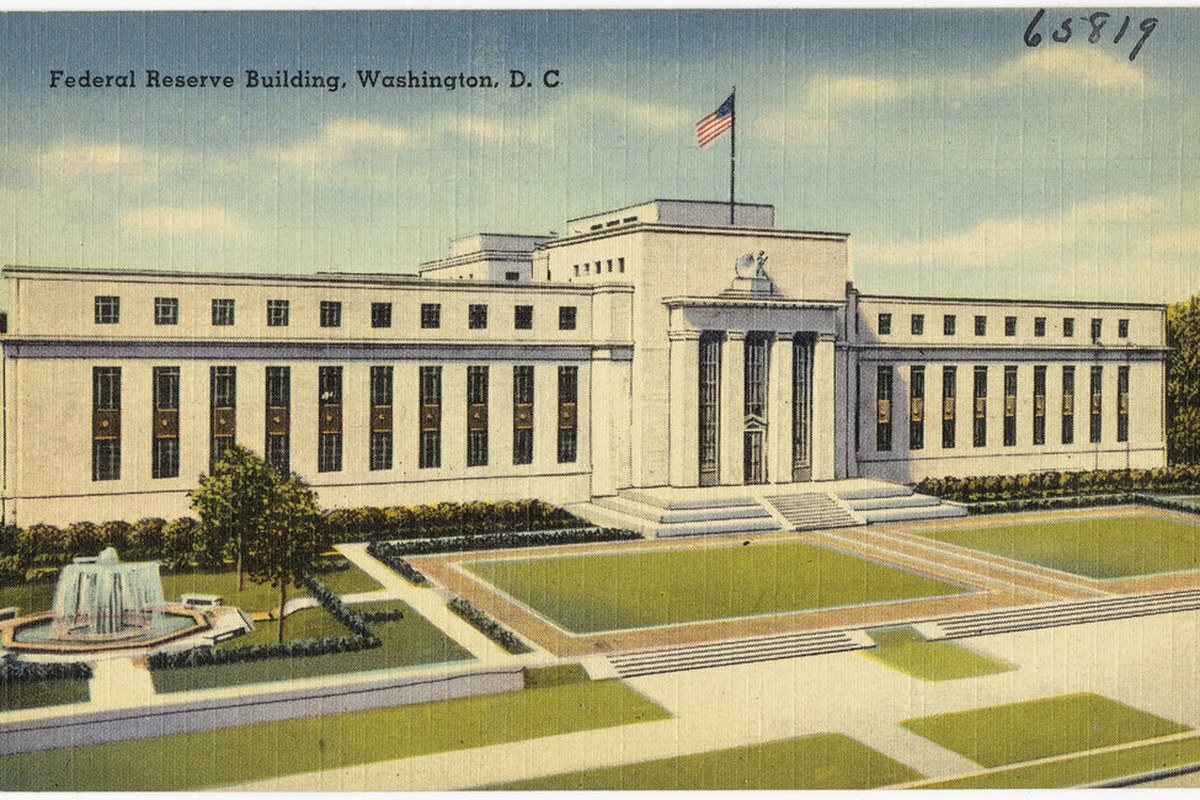
Historic Federal Reserve Building postcard, issued circa 1930-1945 by The Union News Company; Boston Public Library via Flickr. Cropped and resized. Licensed under CC BY 2.0.
Quick answer: The Federal Reserve schedules a two-day FOMC meeting for July 28-29, 2026, with the policy event at 2:00 p.m. ET on July 29 and a 2:30 p.m. press conference. Kalshi's exact event is KXFEDDECISION-26JUL. Its five listed outcomes are mutually exclusive, and the event record points to the Federal Reserve as the settlement source. This static page shows no live odds or volume; verify the exact market and order ticket directly before relying on any price or cutoff.
The Federal Reserve's FOMC calendar lists the meeting for July 28-29. Its July 2026 event calendar lists the FOMC event at 2:00 p.m. ET on July 29 and a press conference at 2:30 p.m. ET. These Federal Reserve times establish the public event schedule; they do not, by themselves, establish when a Kalshi order can last trade.
On the July 19 API snapshot, the event contained five active, mutually exclusive markets:
The event record identifies the Federal Reserve as its settlement source. The generic terms name the Federal Reserve System as the Source Agency. The exact event's secondary rules also state that if the scheduled meeting is canceled and does not occur on its scheduled date, the maintain-rate outcome resolves Yes and all other outcomes resolve No.
Preserve the operators exactly. In particular, do not silently rewrite >25bps as another threshold. The C26 market's title contains the greater-than sign, while its API primary-rule text omitted that sign on the review date. The live market page and exact rules must resolve that discrepancy, not an editorial guess.
Three official records sit close together but are not identical:
This page does not promise a post-announcement trading window and does not select a universal cutoff. Recheck the exact market, order ticket, and rules before the event. If the displayed times still disagree, preserve evidence and seek clarification from Kalshi.
A last trade, best bid, best ask, order-book depth, and full-order execution cost are different observations. A displayed cent value is not automatically an exact probability and does not show the executable price for an arbitrary order size. Live fields also become stale quickly.
If a future update needs a market snapshot, it should save the UTC timestamp, exact ticker, exact fields, official source URL, raw response receipt, and SHA-256. This guide deliberately keeps those dynamic values out of the public copy.
The repository's July source brief records the checked event fields, exact API digest, timing conflict, outcome wording conflict, cancellation treatment, and image provenance. The page should be refreshed before the event and updated from the official Federal Reserve release after the decision rather than carrying a pre-event label indefinitely.
Not financial advice. This site provides educational information only. Trading involves risk, and you can lose money. Verify current market rules and do your own research.