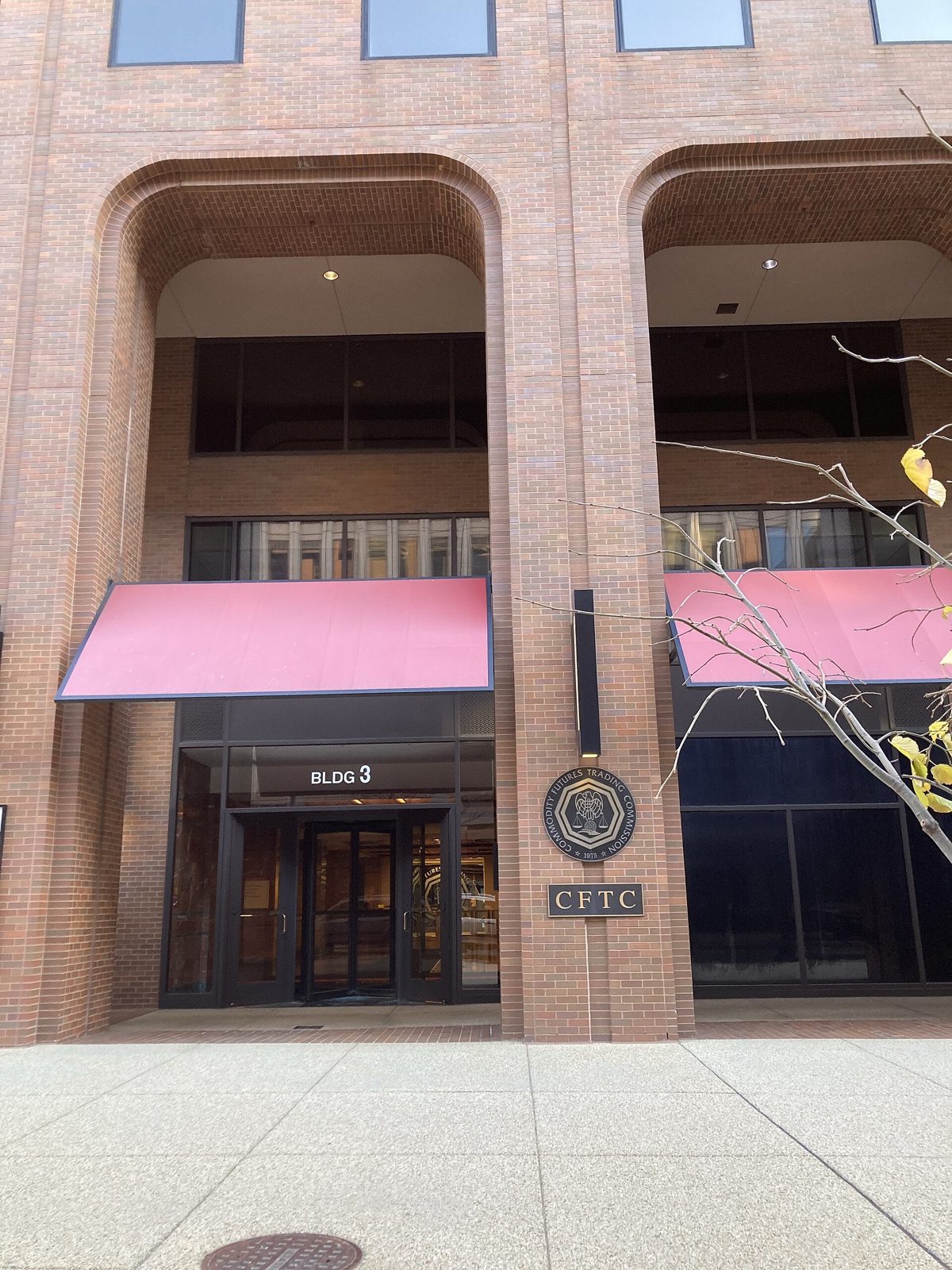
Photo: Dclemens1971 / Wikimedia Commons, CC BY 4.0. Displayed with CSS crop; source file unchanged.
Source-backed answer: KalshiEX LLC is a real US exchange listed by the Commodity Futures Trading Commission as a designated contract market. The CFTC issued its designation order in November 2020. That verifies a regulated exchange status; it does not mean trading is risk-free, every contract is a good trade, every user is eligible, or every account and platform incident is impossible.
Primary sources I checked: reviewed July 17, 2026: CFTC designation announcement, CFTC Kalshi organization filing, Kalshi Member Agreement v1.6, Kalshi account-security guidance, and CFTC 2026 prediction-markets enforcement advisory. This is not legal, tax, or financial advice.
"Legit" combines several different questions: Is the entity real? Is it regulated? Can a user still lose money? Can an account be phished? Can a contract be misunderstood? The official evidence answers the first two; the remaining questions require a separate risk check.
The CFTC announced on November 4, 2020 that it had issued an Order of Designation to KalshiEX LLC, giving it designated contract market status. The agency's organization filing currently shows Kalshi as Designated and links the designation order and later filings.
A designated contract market must operate under the Commodity Exchange Act and CFTC regulations applicable to DCMs. Kalshi also publishes regulatory documents, a Member Agreement, rulebooks, fee schedules, and market-specific rules. Those are concrete, independently checkable facts.
Kalshi's current Member Agreement states that event-contract trading can involve substantial loss, describes it as highly speculative, warns that fees add to losses or reduce earnings, and makes the trader responsible for understanding each contract's specific rules. Those warnings belong in any honest answer to "Is Kalshi safe?"
| Risk | What can go wrong | Practical check |
|---|---|---|
| Outcome risk | The event resolves against the position and a purchased event contract can lose the amount paid plus applicable fees. | Risk only an amount that can be lost without affecting essential finances. |
| Rule risk | A headline can sound broader than the exact settlement condition, source, threshold, or deadline. | Read the full market rules and named settlement source before the order. |
| Liquidity risk | A thin order book can create a wide spread, partial fill, worse average price, or difficult exit. | Inspect both sides and depth; use a limit price and the slippage calculator. |
| Fee risk | Trading and funding fees can make a seemingly positive payoff unattractive. | Use the fee on the live order ticket and review the current fee guide. |
| Account risk | A reused password, exposed code, lost email access, or unauthorized device can compromise an account. | Use a unique password, keep email and phone current, and enable 2FA. |
| Phishing risk | A fake site, message, support agent, or payment request can steal credentials or funds. | Log in only at kalshi.com; never share verification codes or send funds to "verify" an account. |
| Eligibility risk | Location, status, product, payment rail, or current terms can limit access. | Check current eligibility and the Member Agreement instead of relying on an old review. |
Short answer: Kalshi is not a bank, so do not treat a Kalshi balance or an event contract as if Kalshi itself were FDIC-insured. The FDIC says its insurance covers deposits at an FDIC-insured bank, not non-deposit investment products or the failure of a non-FDIC-insured institution. A bank used in a custody or payment chain may itself be FDIC-insured, but whether particular cash is covered depends on the account ownership and the bank's records; verify Kalshi's Member Agreement and current funding disclosures before depositing.
Regulation and deposit insurance are different questions: CFTC designated-contract-market status is regulatory oversight, not deposit insurance, and it does not cover trading losses. The FDIC deposit-insurance explainer above was checked August 16, 2026.
Kalshi's account-activity guide recommends a strong unique password, two-factor authentication, and caution around phishing. It says employees will not ask for a password or one-time verification code and will not ask someone to send money or crypto to verify an account.
In February 2026, the CFTC's Division of Enforcement published an advisory following cases involving misuse of nonpublic information and fraud in prediction markets traded on KalshiEX. That evidence cuts both ways: enforcement and exchange penalties show that rules and oversight mechanisms exist, while the underlying cases show that regulation cannot prevent every improper act.
A sensible conclusion is narrower than either "regulated means perfectly safe" or "a misconduct case means the exchange is fake." Verify the entity and rules, then evaluate the individual contract, counterparty environment, price, and personal account security.
This review focuses on Kalshi event contracts. Kalshi's perpetual-futures guide describes a separate margin account, leverage, liquidation risk, funding payments, and a distinct fee schedule. Do not use an event-contract loss model or payout calculator to judge a leveraged perpetual-futures position.
KalshiEX LLC is listed by the CFTC as a designated contract market, and the CFTC issued its designation order in November 2020. That verifies a regulated exchange status, but it does not guarantee profits, correct forecasts, uninterrupted access, or freedom from fraud and trading losses.
No trading platform is risk-free. Use the official site, a unique password and two-factor authentication, never share verification codes, read each contract's rules, inspect liquidity and fees, and risk only an amount you can afford to lose. The contrast with unregulated venues is stark: crypto "trading signal" groups, for instance, operate with none of these safeguards; ten US enforcement actions document how those schemes end.
No. Kalshi is not a bank, so a Kalshi balance or an event contract should not be treated as FDIC-insured. FDIC insurance covers deposits at FDIC-insured banks, not non-deposit investment products, and CFTC designated-contract-market status is regulatory oversight, not deposit insurance.
Yes. Kalshi's Member Agreement describes event-contract trading as highly speculative and says trading fees can add to losses or reduce earnings. A wrong outcome, poor fill, wide spread, fee, or rule misunderstanding can reduce or eliminate the amount at risk.
The CFTC designated KalshiEX LLC as a US contract market. That is an exchange-level regulatory status, not a promise that every person, jurisdiction, payment method, product, or contract is available. Users must check current eligibility and terms.
No. Regulation creates rules, oversight, records, and enforcement mechanisms; it does not prevent every misuse or bad outcome. In February 2026, the CFTC published an advisory about enforcement cases involving misuse of nonpublic information and fraud on prediction markets traded on KalshiEX.
Not legal, tax, or financial advice. This independent review is not affiliated with Kalshi. Regulatory status does not remove market, product, account, technology, eligibility, or fraud risk. Verify current official records and terms before creating an account, moving funds, or trading.
